11 Things You Never Knew About Diamond Gemstones
There’s no doubt that if you asked most people to name a gemstone, a diamond would be one of the first they would come up with. The sparkling colourless stone has been the mainstay for fine jewellery for centuries and is also one of the hardest natural substances known to man. There have been many famous diamonds throughout history with amazing stories associated with them.
Diamond is one of the most abundant elements on the plant
Diamond is made from carbon, one of the simplest and most abundant elements on the planet. It forms at high temperature and pressure depth around 80-120 miles into the Earth’s mantle. It takes over one billion years to form and are brought to the surface by volcanic eruptions.
It is colourless and one of the hardest materials
Diamonds are usually colourless, yellow, brown or grey though others colours do occurring including blue, green, violet, red and a translucent white. It is the hardest material known on both the Vickers and Mohs scales and even its very name refers to its hardness.

Diamond’s Greek name means ‘unbreakable’
The word diamond comes from a Greek word ‘adamas’ that means unalterable or unbreakable. They believed the stones would improve warriors muscles and make them stronger.
Diamonds were originally mined in India
It is thought that diamonds were first discovered in alluvial deposits of stone in India going back at least 3,000 years, though some sources date their first use back to around 6,000 years ago. They were used as religious icons in India and people around the world quickly came to realise their hardness was useful in tools.
Alexander the Great is said to have brought diamonds to Europe in 327 BC from India and they were seen as a medical aid as well as for jewellery.
They were said to be ‘poisonous’ to stop miners eating them
By the 11th century, people believed they were poisonous if ingested, though this may have been a fiction created to stop diamond miners swallowing the stones as a means to stealing them.
Diamond cutting as a trade start in 14th century Venice
The diamond cutting trade took off in Venice around 1300 as the desire to make different shapes and cuts of stones grew. By the 16th century, the stone had become a symbol of wealth and prosperity but India was still the only source.

Modern diamond cutting and cuts were developed in the 1900s including the Round Brilliant cut, created by Marcel Tolkowsky in 1919. Around the mid 1900s, diamonds were discovered in Eastern Australia while the richest deposit in the world, near Argyle Pipe in Western Australia, was found in 1979.
Types of diamonds are found away from Earth
Diamonds aren’t only found on Earth – a diamond called carbonado was found in South American and in Africa and was believed to have been deposited there through asteroid impact some 3 billion years ago. These diamonds would have developed in somewhere in space, on the asteroid and were left here when it burned up in the atmosphere. The Popigai crater in Russia is the largest diamond deposit in the world believe to have been formed by an asteroid impact and has trillions of carats of the gemstone present.
Diamonds are associated with the seventh Chakra
Diamonds are said to active the seventh Chakra, Sahasrara to unit the mind and the body. It can open spiritual doors and symbolise perfection because they are so hard to break.
It is the April birthstone
For anyone like me, born in April, this is our birthstone (so not much chance of a themed collection there!) and the stone is also associated with the 60th wedding anniversary.
Diamonds are measured by the 4Cs
When choosing a diamond, you need to understand something referred to as the Four Cs – carat, cut, colour and clarity. These are the four factors used to rate the quality of the gemstone and also affect the price you will pay for it.
Carat
Carat or carat weight is the weight of the stone with one carat being equivalent to around 0.2 grams. It is measured in ‘cts’ or in points with one carat being divided into 100 points. Obviously, the larger the carat weight, the more expensive the stone. Also the bigger the stone and this can have an impact on its wearability – do you want to wear a very large stone on a daily basis where it may get chipped or scratched? For this reason, rings such as engagement rings often combine a number of smaller stones to allow them to be worn on a daily basis.
Cut
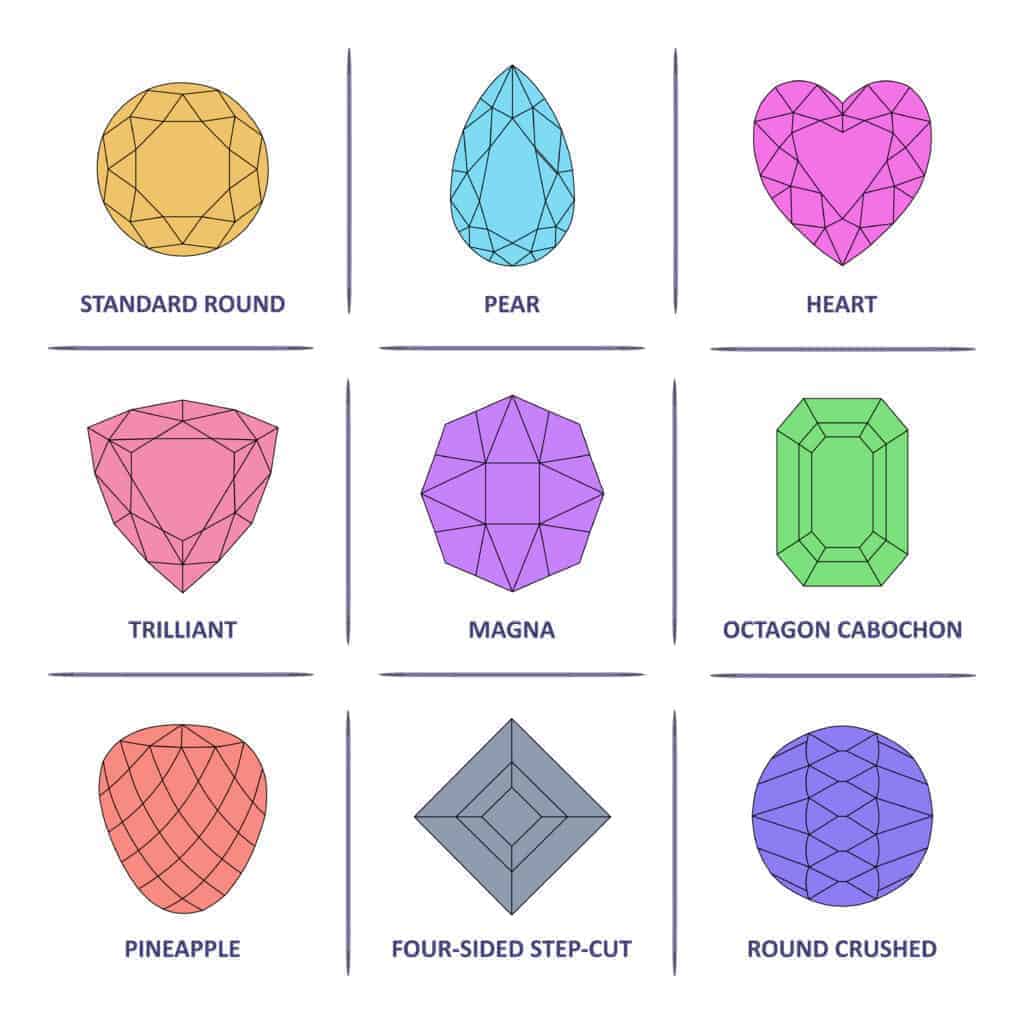
The cut of a diamond is perhaps the most important factor in deciding its value. The cut allow sparkle from the stone and means it will handle light well, making it look good when worn. Cuts are graded from ‘super ideal’ to ‘very good’ with the former being the highest ranking. Cut is not the same as the diamond shape and is all about the facets of the stone and the light they create.
Colour
Colour may sound strange for an essentially colourless stone but does have a factor in the quality of the stone. Diamonds are graded between D, which is colourless, through to Z, which has a yellow tint. The whiter the diamond, the higher its value so D graded diamonds are the most expensive.
Clarity
The final of the Four Cs is clarity. Gemstones can be affected by flaws called inclusions and in diamonds, the fewer there are, the better quality the stone. These are graded from FL, meaning flawless, through to I3 where there are visible inclusions. These inclusions can be made by air bubbles as the stone formed, other minerals or even tiny cracks in the stone.
There are lots of famous diamonds
Cullinan Diamond
The Cullinan Diamond is the biggest gem-quality diamond weighing in at 3,106.75 carats. It was discovered in 1905 in the Premier No.2 mine just outside Pretoria, South Africa and was cut into a number of gemstones, including the Cullinan I, also known as the Great Star of Africa. At 530.4 carats, it is the biggest polished white diamond in the world and held the record for the largest diamond of any colour until the discovery of the Golden Jubilee Diamond in 1985.
The second stone to be cut from it is the Cullinan II or the Second Star of Africa, itself a massive 317.4 carats and sitting 4th on the list. Both of the Cullinan diamonds are currently part of the Crown Jewels of the UK, held in the Royal Collection by Queen Elizabeth II.
The Orlov
The Orlov, sometimes called the Orloff, is a part of the Diamond Fund of the Kremlin of Moscow. The stone has a colourful history – at 300 carats with a slight bluish-green colour, it is an exceptionally pure stone that has been cut into a Mogul-cut rose. One story about the origins of the stone say that it was originally set in the idol of Vishnu, a Hindu god, in the sanctuary temple of Sriangam until it was stolen by a French deserter in the 1700s. There were actually two matching stones but the thief was so terrified at the idea of divine retribution, he only stole one. The stone was taken to Madras and sold to an English sea captain for £2000.
.jpg)
Next the stone arrived in Amsterdam there the Russian count, Grigori Orloff was living. The former lover of Empress Catherine, Orloff heard about the stone and bought it for £90,000, taking it back to Russia for his lover. Catherine accepted the stone and mounted it on the Imperial Sceptre while gifting Grigori a marble palace in exchange for the stone. But it didn’t serve him well as the pair fell out and he died of a broken heart in 1783.
Tiffany Yellow Diamond
The Tiffany Yellow Diamond is the biggest yellow diamond ever found at 287.42 carats. It was found in Kimberley mine in South Africa in 1878 and was bought by Charles Tiffany, the founder of Tiffany & Co, famous New York jewellers. He set his gemmologist George Frederick Kunz to work on the stone, reducing it to the current size of 128.54 carats at which time it was mounted by Jean Schlumberger. Kuntz was just 23 at the time and the cutting process involved adding a massive 32 facets to the accepted number for a square antique brilliant cut. The result is a quality of light in the stone that has only been equalled with modern cutting techniques.
The stone has only been worn by two women during its lifetime – Mrs Sheldon Whitehouse at the 1957 Tiffany Ball in Newport, Rhode Island and by Audrey Hepburn in the 1961 during the publicity photos for Breakfast at Tiffany’s.
Koh-I-Noor
The Koh-I-Noor or Mountain of Light is a large colourless diamond found in Andhra Pradesh, India, in the 13th century. Originally it was 793 carats and owned by the Kakatiya dynasty before changing hands numerous times and ending up as a possession of Queen Victoria in 1849. Prince Albert was unhappy with the dull and irregular look of the stone so ordered it cut down to 186 carats in an oval-cut, brilliant cut. The diamond is now in the Queen Mother’s Crown, part of the Crown Jewels and is held in the Tower of London.
Daria-I-Noor
The Daria-I-Noor or Sea of light is a 182 carat pale pink diamond that came from the Paritala-Kollur Mine in Andhra Pradesh, India – the same place as the Koh-I-Noor. It was first owned by the Kakatiya dynasty then looted by the Khilji dynasty and given to the Mughal emperors. The Shah of Persia took the stone when he invaded northern India in 1739 as part of the payment for the Mughals to retain their throne. It is now a part of the Iranian Crown Jewels.
_Diamond_from_the_collection_of_the_national_jewels_of_Iran_at_Central_Bank_of_Islamic_Republic_of_Iran.jpg)
Spoonmaker’s Diamond
Pride of place in the collection of the Topaki Palace in Istanbul is the Spoonmaker’s Diamond, an 86 carat pear shaped diamond and the 4th largest of its kind in the world. It is set in silver with 49 old-mine cut diamonds surrounding it in two rows, these brilliant cut stones giving it the appearance of the ‘full moon shining amid the stars’.
There are many stories about how the stone came to the palace including through the hands of Ali Pasha of Tepelena, an Ottoman governor of modern-day Greece and Albania. Other stories connect it with the Pigot Diamond, held by the British governor of Madras, India in the 1760s, Lord Pigot.
Large Diamonds
Excelsior Diamond
Before the Cullinan Diamond was discovered, the record for the largest gem quality diamond was held by the Excelsior Diamond. Found in 1893 in the Jagersfontein Mine near Kimberley, South Africa, it was a blue-tinted stone with a weight of 995.2 carats. It was cut into ten stones weighing between 13 and 68 carats.
Centenary Diamond
The Centenary Diamond was the third largest to come from the Premier Mine in South Africa, after the Cullinan I and II. At 273.85 carats, the stone has the highest grade rating of colourless diamond due to its internal and external flawlessness. It was named to mark the Centenary Celebrations of the De Beers, the company owning the mine, which was two years after it was discovered in 1986.
Cursed Diamonds
Hope Diamond
Without doubt the most famous cursed diamond is the Hope Diamond. The deep blue stone came from India and is believed to have travelled the world with a curse on any wearer. It was first known to be owned by Louis XIV, King of France who bought it from a gem merchant called Jean Baptiste Tavernier when it was a massive 112 carats. He had it cut down to 67 carats and used in the crown jewels.
.JPG)
It was inherited by the next king, Louis XV who added it to the Emblem of Golden Fleece. It was stolen during the French Revolution and vanished for 20 years, appearing once more in England in 1812 under the ownership of collector Philip Henry Hope. After his family sold it, it seemed to move around owners until it was purchased in 1912 by Evelyn Walsh McLean. She had it reduced further to 45.52 carats and claims that the curse has never affected her.
When she died it was bought by Harry Winston the famous jeweller who donated it to the Smithsonian Museum where it now resides.