
15 Things You Never Knew About the Turquoise Gemstone
I’ve never been sure why, but you are always drawn to certain colours. And when you make beaded jewellery, you often find you are drawn to some gemstones as well. For me, one of those is turquoise. I’m a turquoise-green-purple-blue person and I love the shades of turquoise gemstone. To help you love it too, let’s get to know it a bit better.
The science stuff
Turquoise is a type of phosphate that has copper and aluminium in it. It isn’t one of the harder gemstones, just a 6 on the Mohs scale but it has long been popular for jewellery, ornaments and carving. It does come in different shades of turquoise, depending on where it comes from and it can also be dyed by substances such as Prussian blue to enhance the colour and darken the veins.
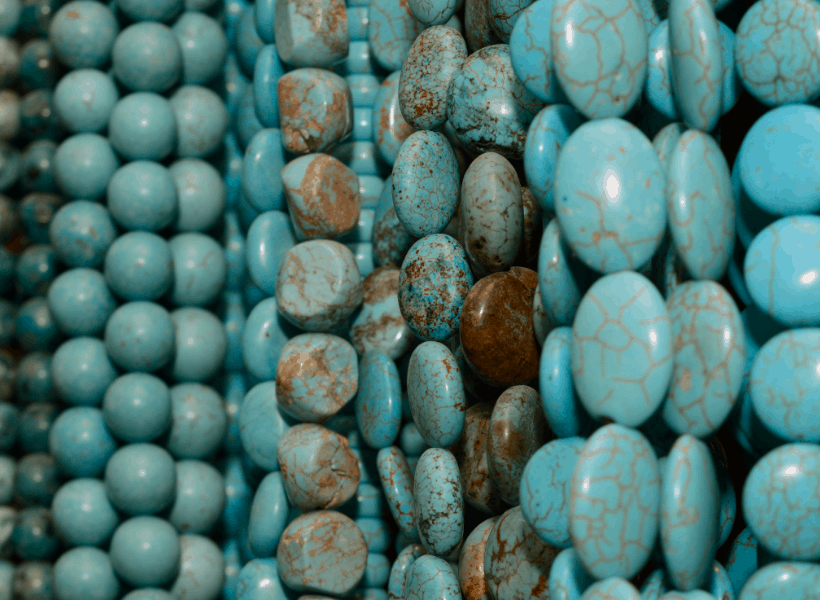
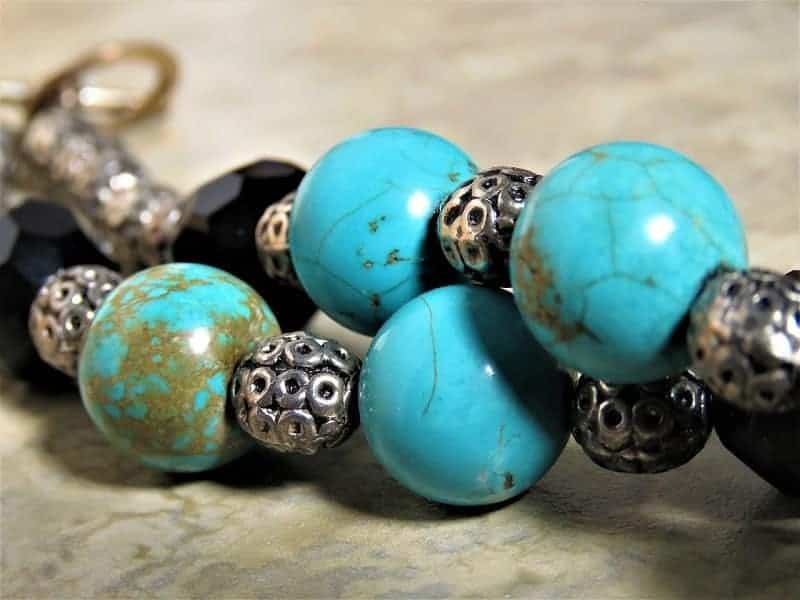
Turquoise is often used for beads and also as cabochons with a flat back, mounted onto a pendant. It can be used as rough chips and as tumbled stones as well as carves – cameos are sometimes made from it. It doesn’t have the sparkle of a stone like sapphire, being more opaque in colour.
1. There are different types from around the world
Turquoise gemstones come from around the world and the different locations can also mean different colours. Some of the most famous variations include:
- Eilat stone – greenish blue turquoise often found mixed with malachite and chrysocolla, found near Eilat in Israel
- Kingman turquoise – strong coloured stones from the Mineral Park Mine near Kingman, Arizona
- Navajo turquoise – a general term for south-west USA turquoise, including Arizona that has black or brown patterns
- Persian turquoise – ancient deposits in modern-day Iran, around the Nishapur area, often without any black or brown markings
- Tibetan turquoise – more vivid blue shade from Tibet

2. Turquoise gemstone was one of the first to be mined
Turquoise is said to be one of the first gemstones mined and it was popular in cultures around the world. The Shang Dynasty of China used it and it was brought to Europe along the Silk Road from there. It was also popular in ancient times in Tibet and Mongolia where greener shades were preferred.
3. Egyptian artefacts with turquoise go back to 5000BC
Turquoise beads have been found in Egyptian artefacts that date back as far as 5000 BC. The Sinai area of Egypt was historically where turquoise was mined and as early as the 1st Dynasty of Egypt, around 3000 BC, the stone was found there, and the region was known as ‘country of turquoise’ by native people. The two most important mines were Serabit el-Khadim and Wadi Maghareh, the oldest known mines. Turquoise was a feature of the death mask of Tutankhamun.
4. The Aztecs valued it more than gold
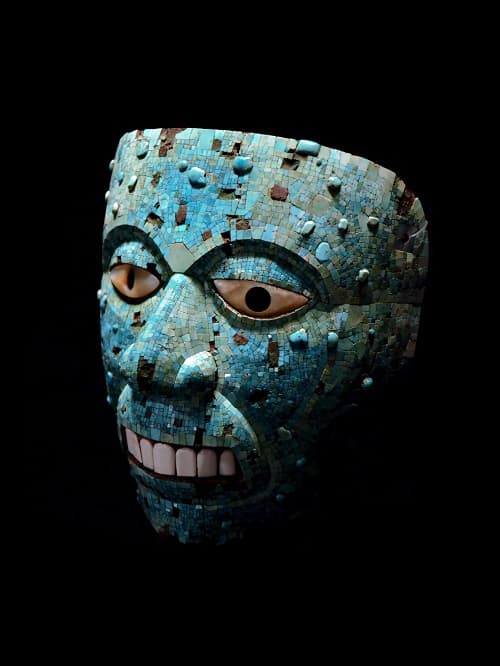
To the Aztecs, turquoise was called chalchihuitl and was worth more than gold and emeralds. They believed the god Quetzalcoatl taught them how to cut and polish the stones and chiefs work strings of turquoise beads to show their importance. Pieces of turquoise were placed in the mouths of the dead if they were important people and masks were also made from it along with garnet and shell.
5. It was prized by Native American cultures
Many Native American cultures greatly prized turquoise. For the Apache, it was known as duklij and had talismanic properties, so they carved it into beads, amulets, pendants and fetishes. Shamans would not receive proper recognition if they didn’t have turquoise gemstones on them.
The Navaho used to grind it with coral to make sacred sand mandalas and call the rain. Turquoise stones were often seen on the walls of their homes, as vessels and in their jewellery.
6. The word comes from French for ‘Turkish’
Turquoise is a relatively recent word for the stone. The Greeks knew is as callais and to the Iranians is was called pērōzah which meant ‘victory’. The word turquoise comes from the French word ‘turquois’ which meant Turkish because it was through Turkey that the stone first came to Europe.
7. It was a symbol of male power
Turquoise was seen as a symbol of male power but in a good way, bringing together male and female energies and stimulating romantic love. For others, it was a more traditional male symbol – Anselmus de Boot, the court physician to Emperor Rudolph II, said that no man ‘considered his hand well adorned’ unless he wore a turquoise.
8. It is the December birthstone
Turquoise is the birthstone for December and also for those born around the time spring begins, normally from 20th March until 19th April. It is the stone for the star sign of Sagittarius from 22nd November until 21st December.
9. Turquoise is a stone of protection
Some people believed that turquoise was a stone of protection, that it would break to warn owners of danger in the same way that malachite were said to do. Another belief was that its colour would change when there was a danger. It could protect from falls and be often added to a horse’s bridle to protect the rider.
10. It has calming properties
Turquoise is said to help you remain calm and to make your positive affirmations become a reality. It is work as a good luck charm for health and abundance.
11. Turquoise gemstones promote leadership
Turquoise has the power to promote leadership according to traditional beliefs. In the workplace, it is associated with relocation or regular travel as well as helping people avoid unwise investments. It can help writers to overcome writer’s block and to help people communicate, making it a good stone for people involved in jobs where this is key. It can ease anxiety and is recommended for people in stressful jobs.
12. It helps to strengthen the body
Tradition says that the turquoise gemstones are strengthening stones that help to offset the effects of exhaustion, depression or panic attacks. It can help to boost the immune system and ease viral infections. Wearing it is said to help reduce rheumatism, problems such as gout and issues with the stomach. It can also balance the imbalance that leads to migraines.
13. It is placed on the Third Eye in Chakras
In Chakra healing, turquoise is used to strengthen the meridians of the body and the subtle energy fields we all have. It helps with the communication between physical and spiritual words and is placed on the Third Eye to help with intuition and meditation. It can also be used on the Throat Chakra to clear old vows and let people express themselves.
14. Turquoise is the colour of the vernal equinox
The colour of turquoise is the colour of the vernal equinox which takes place around 21-23rd March each year. It is the point where the blues of winter become the greens of spring and is a time of discovery and hope.
15. It uses water energy in Feng Shui
For followers of Feng Shui, turquoise is a water energy, quietly strong and pure. It is formless but also powerful and brings regeneration and rebirth. It is used in spaces for repose, calm meditation or prayer. Water is also associated with the north part of the room or the home and the career and life path areas, flowing energy as life unfolds.
Stunning gemstone
Many of the beliefs about turquoise gemstones have been around for hundreds of years and there’s no scientific evidence to show they are true (so please, don’t take this as medical advice!) but if you love jewellery with meaning, then wearing these stones would definitely count.


