11 Things You Never Knew About Amethyst Gemstones
When it comes to gemstones, diamonds are probably the most recognisable but also the most easily confused. When you talk about amethyst, there isn’t much to confuse – bright purple, strong shades, the most ‘proper’ purple gemstone available. Amethyst is also the birthstone for February and here we look at the stone in a little more detail.
Amethyst is a type of quartz
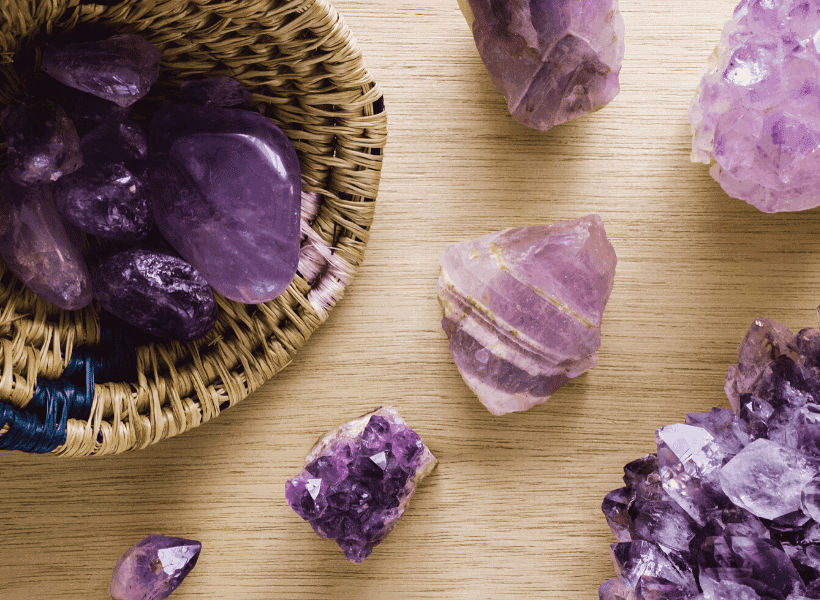
Amethyst is actually a type of quartz and its vibrant colour comes from trades of iron in the mineral. It has the same hardness as quartz stones which makes it ideal for jewellery making, in which it has been used for thousands of years.
The colour of amethyst is described as purple but in truth it can vary from a light pinkish violet shade right through to the dark purple it is most well known for. The ideal colour is known as ‘Deep Siberian’ and is said to be 75-80% purple with the remaining being a blue and red secondary hue.

Brazil is a top producer of amethyst
One of the top places for amethyst is Minas Gerais in Brazil where it is found within volcanic rocks. Neighbouring Rio Grande do Sul is another world leading producer as are a number of other states in Brazil as well as neighbouring Uruguay.
The largest open case vein of amethyst in the world is found in Maissau, Lower Austria while much fine quality gemstone comes out of Russia, particularly in the Mursinka area where it appears in cavities in granitic rocks.
Southern India sees some production while Zambia is also near the top of the list of world producers. The US has numerous sites where amethyst is found including in Arizona, Colorado, Texas and Wisconsin. The largest mine in North America is in Thunder Bay, Ontario, Canada.
Ametrine is amethyst and citrine
The stone ametrine is a naturally occurring mixture of amethyst and citrine, also known as trystine, and comes from Bolivia primarily. Both colours can be seen in the stone and it was said to have been first brought to Europe by the conquistadors after one married a princess of the Ayoreos tribe and brought the stone back to the Queen of Spain.
Ancient Greeks believed it helped prevent drunkeness
In Ancient Greece, amethyst was considered a strong antidote against becoming drunk and its very name ‘amethystos’ means ‘not drunken’. But weirdly it was associated with Bachus, the god of wine!
Ancient Egyptians carved with it
The stone was also used by the Ancient Egyptians and its use for intaglio engraved gems was discovered in early times. They used the stone to protect against harm and as a protective amulet.

It became associated with healing and level headedness
By medieval times, it was believed that amethyst helped people to be level headed as well as to heal people and amulets of the gemstone were worn into battle. The Anglo-Saxons used the stone in beads, as found in graves around England while the Western Christian bishops had the stone in their Episcopal ring.
There are some very famous amethysts
For fans of amethyst, one of the must see exhibitions around the world is The Empress of Uruguay in the Atherton Tablelands in Cairns, Australia.
Another famous set of amethysts are on the Duchess of Windsor’s Necklace. The Duke of Windsor, formerly King Edward VIII, married an American lady named Wallis Simpson and abdicated from the throne. The couple then married and were known as jewellery connoisseurs. Among their collection was a necklace made in 1947 by Cartier that contains 29 step cut amethysts on a bib style necklace, along with turquoise cabochons and brilliant cut diamonds, all set on gold. After the Duchess’ death in 1986, the necklace was sold by Sotheby’s in Geneva for $605,000.
Another famous amethyst is mis-named the Delhi Sapphire and comes with its own mystery. The stone was stolen from an Indian temple and is said to carry a curse. A curator for the British Natural Museum called Peter Tandy found it in the vaults of the museum along with a letter from the former owner saying it bought bad luck. He ignored the letter and took the stone to a science symposium only to be caught in a horrific thunderstorm. Shortly afterwards he died from kidney stones. The stone today is on show in the Natural History Museum in London.
This is the world’s biggest amethyst geode standing at three metres or eleven feet tall and weighing two and a half tonnes. It is a combination of thousands of beautiful purple crystals that are AA rated and create an amazing spectacle.
The darkest stones aren’t the best
When selecting amethysts for fine jewellery, the advice is to avoid the very darkest coloured stones as they don’t let very much light in. A good, vibrant shade is best and will work best in any setting. Carat prices aren’t too significant with this stone as large stones are often found around the world and this also means that almost any cut of stone can be achieved.
Opaque marks mean the real thing
When looking at beads, amethyst comes in all shapes and sizes from random chips through to shaped pendants and most have that opaque look that marks them as the real gemstone, not an artificial one.
It is associated with the Pisces star sign
Amethyst is the birthstone for February as well as being associated with the star sign of Pisces. It is also the gemstone associated with St Valentine’s Day.
Amethyst crystals is used to stop nightmares
As well as its association with being clear headed and avoiding drunkenness, the stone is also said to help against addiction. Traditional beliefs say the stone can help to relieve pain and reduce swelling by calming the nervous system as well as helping with insomnia and warding off nightmares – this is done by placing a crystal beneath the pillow at night.